It Arrived As Infrastructure

When OpenAI published its framework for government and national security partnerships earlier this month, most of the coverage treated it as a transparency gesture. A company getting ahead of the optics of selling to states. Read more carefully, it is something else: a company setting the terms under which governments may access its capabilities. That is a different kind of document. It is not a press release. It is a pre-negotiation.
The distinction matters enormously for African governments, most of which are simultaneously building AI strategies, celebrating governance milestones, and signing enterprise software contracts, without a clear-eyed view of how those three activities interact.
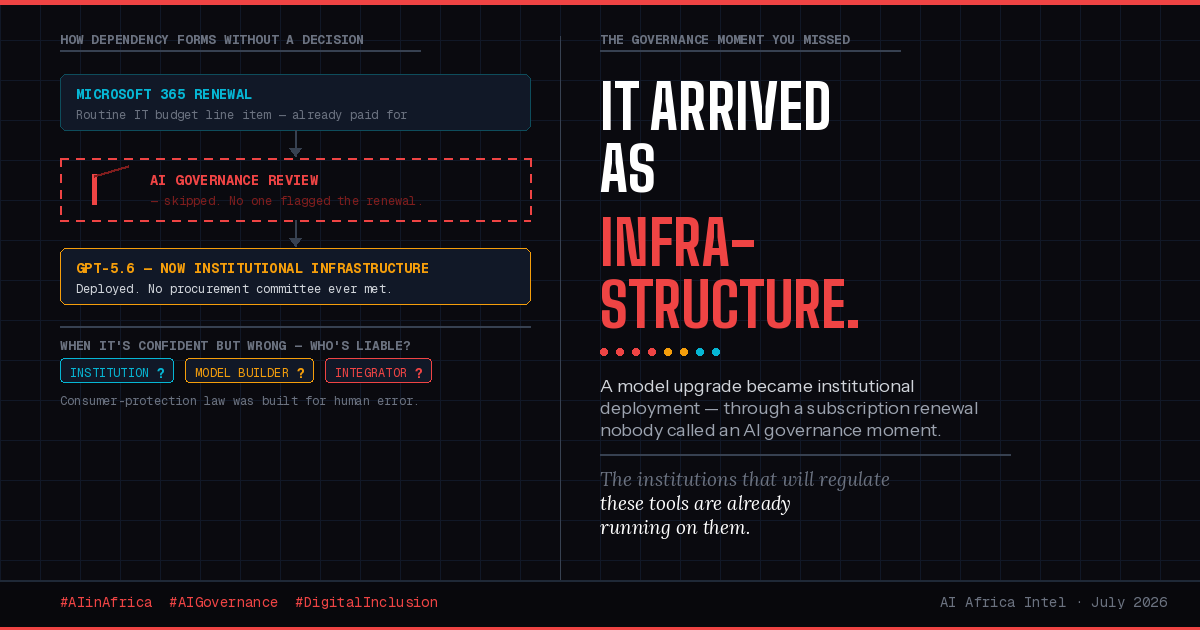
Start with the software contracts, because they are already done. GPT-5.6 did not require a procurement committee at most African universities, ministries, or large enterprises. It arrived through Microsoft 365 Copilot, which those institutions already pay for as productivity infrastructure. A model upgrade became institutional deployment without a single deliberate adoption decision. This is how frontier AI capability becomes dependency: not through a signed partnership agreement, but through a software subscription renewal that nobody flagged as an AI governance moment. The institutions that will eventually need to regulate these tools are already running on them.
Then look at Nigeria’s responsible AI ranking, which is a genuine signal of governance momentum and deserves to be named as such. Nigeria’s National Information Technology Development Agency has been building policy infrastructure with real seriousness, and its rise to the top of African responsible AI rankings reflects that work. But a ranking is only as meaningful as the framework that produces it. The frameworks that generate responsible AI rankings. Most of them produced by European and North American research institutions, carry embedded assumptions about what responsible deployment looks like, which risks matter most, and which institutional structures count as accountability. Those assumptions were not built with Lagos or Abuja in mind. They were not built with informal economy integration, multilingual last-mile delivery, or financial systems where a significant share of the population remains outside formal banking, in mind. Nigeria’s achievement within that framework is real. Whether the framework itself reflects Nigerian risk profiles and institutional realities is a separate question the ranking cannot answer.
This is the structural bind: African governments are being measured against governance standards they did not write, at the same moment that the companies they would govern are publishing the principles under which they will work with states. OpenAI’s government partnerships document effectively pre-negotiates the terms of AI access before any African government sits down at the table. Engaging with it critically requires policy teams that can read a framework document and identify what it assumes, what it excludes, and where its interests diverge from the institution reading it. That capacity is not widespread. It is not a criticism of intent. It is a description of where technical policy depth currently sits on the continent.
The enterprise reliability data adds a third layer. A VentureBeat Research survey of 573 technical leaders found that half of enterprises have deployed an AI agent or large language model feature that passed internal evaluations and still caused a customer-facing failure. One in four of those enterprises experienced it more than once. This is the global baseline, from organizations with mature engineering teams and dedicated AI governance functions. African financial institutions and public sector bodies adopting agentic AI are not entering a stable environment where the hard problems have been solved. They are entering a market where well-resourced global enterprises are regularly running ahead of their own verification capacity.
For African financial regulators specifically, this should be a live operational concern. Consumer protection frameworks in most African markets were designed around human error and institutional negligence. Categories with clear accountability chains. “The model was confident but wrong” does not fit cleanly into those categories. When an AI agent deployed by a Kenyan bank or a Ugandan telco produces a confident, incorrect output that causes financial harm to a customer, the accountability question is not straightforward. Who is liable: the institution that deployed the agent, the company that built the model, or the vendor that integrated it? Most regulatory frameworks on the continent do not yet have a clear answer. And the window to build that answer before it becomes a crisis is narrowing.
The inclusion stakes here are not abstract. The populations most exposed to agentic AI failures in African markets are often the same populations with the least capacity to navigate redress systems when something goes wrong: rural users accessing financial services through voice interfaces, small traders using AI-assisted credit scoring, patients in under-resourced health systems where AI diagnostic tools are filling gaps that human specialists cannot. When AI governance frameworks are weak, the cost of failure is not distributed evenly. It concentrates at the edges of the system, among the people who had the fewest alternatives to begin with.
None of this means African institutions should slow down adoption. The case for deploying AI in African markets, for reaching the unbanked, for delivering healthcare where clinicians are scarce, for extending credit to small businesses that formal scoring systems ignore - is strong and well-evidenced. What it means is that adoption without governance capacity is a transfer of risk to the most vulnerable users, and that governance capacity requires something more specific than a ranking.
It requires institutions that can read OpenAI’s government partnerships framework and know which clauses to push back on. It requires regulators who can look at a 50% enterprise agent failure rate and ask what that implies for their consumer protection mandate. It requires policymakers who understand that GPT-5.6 arriving through a Microsoft 365 subscription is an AI governance event, even if no one in procurement called it that.
Nigeria’s governance progress is the most actionable signal for the continent this week. Its value depends entirely on whether the institutions behind that ranking have the technical depth to make it mean something when a frontier AI company publishes a framework and calls it responsible partnership.
What I’m Watching
1. When the software subscription becomes the governance event — OpenAI Blog →
GPT-5.6 did not arrive at most African universities, ministries, and large enterprises through a procurement committee. It arrived through Microsoft 365 Copilot, which those institutions already pay for as productivity infrastructure. A model upgrade became institutional deployment without a single deliberate adoption decision. This is worth sitting with: the institutions that will eventually need to regulate frontier AI are already running on it, and the moment of adoption passed without anyone in governance calling it that. African technology oversight bodies and board-level risk committees need a new category. One that treats software subscription renewals as AI governance events, not just IT budget line items.
2. Nigeria’s governance ranking is an achievement. The framework it was measured against is not neutral. — TechCabal →
Nigeria’s rise to the top of Africa’s responsible AI rankings reflects genuine, serious policy work by the National Information Technology Development Agency, and that deserves recognition. The tension worth naming is structural: responsible AI rankings are produced by frameworks built largely within European and North American regulatory traditions, with embedded assumptions about which risks matter most and which institutional structures count as accountability. Those assumptions were not designed around informal economy integration, multilingual last-mile delivery, or financial systems where a significant share of the population remains outside formal banking. Nigeria’s achievement within that framework is real. Whether the framework reflects Nigerian risk profiles is a separate question the ranking cannot answer.
3. A 50% agent failure rate is the global enterprise baseline. African regulators should read that number carefully — VentureBeat →
A VentureBeat Research survey of 573 technical leaders found that half of enterprises have deployed an AI agent or large language model feature that passed internal evaluations and still caused a customer-facing failure. One in four experienced it more than once. These are organizations with mature engineering teams and dedicated AI governance functions. African financial institutions, telcos, and public sector bodies adopting agentic AI are not entering a stable environment where the hard problems have been solved. They are entering a market where even well-resourced global enterprises are running ahead of their own verification capacity. For African financial regulators specifically, the accountability question is live: existing consumer protection frameworks were built around human error and institutional negligence, not “the model was confident but wrong.”
A Reflection
The pattern I keep returning to this week is the distance between policy and impact. Not as a failure of intent, but as a structural feature of how AI governance is currently being designed.
When a government publishes an AI strategy, the timeline almost always runs in one direction: frameworks first, then deployment, then outcomes. The logic seems reasonable. But in practice, the populations most likely to be shaped by AI systems are rarely consulted during the framework stage. By the time deployment arrives, the decisions that matter most, what data was used, what language the system speaks, whose problem it was built to solve. Have already been made.
What I keep noticing is that inclusion tends to appear in these documents as a goal rather than a design constraint. There is a difference. A goal can be deferred. A design constraint cannot. If you are building a voice-based agricultural advisory system and the training data does not include the dialect spoken by smallholder farmers in the regions you claim to serve, no amount of policy language about equity changes the outcome for those farmers. The exclusion is baked in before the first line of code.
This matters more now because the window for shaping foundational AI infrastructure in Africa is not indefinitely open. The models being trained today, the data pipelines being established, the partnerships being signed between African institutions and global AI companies. These are not neutral technical decisions. They are choices about whose knowledge gets encoded, whose language gets legible, whose problems get prioritized.
What this signals to me is that the inclusion lens has to move upstream. Not into the impact assessment, which comes after. Not into the monitoring framework, which comes later still. Into the design brief, before anything is built.
That is a different kind of governance conversation than most policy documents are currently having. And the gap between where that conversation is happening and where it needs to happen is, for now, significant.
One Question
If your institution signed an AI-capable software contract in the last two years — a Microsoft 365 renewal, a cloud services agreement, anything that now ships with an embedded model — did anyone in your governance or risk function review it as an AI adoption decision at the time, or did it arrive as infrastructure?