The Constraint Is the Plumbing

There is a specific kind of expensive mistake that looks, from the outside, like a strategy.
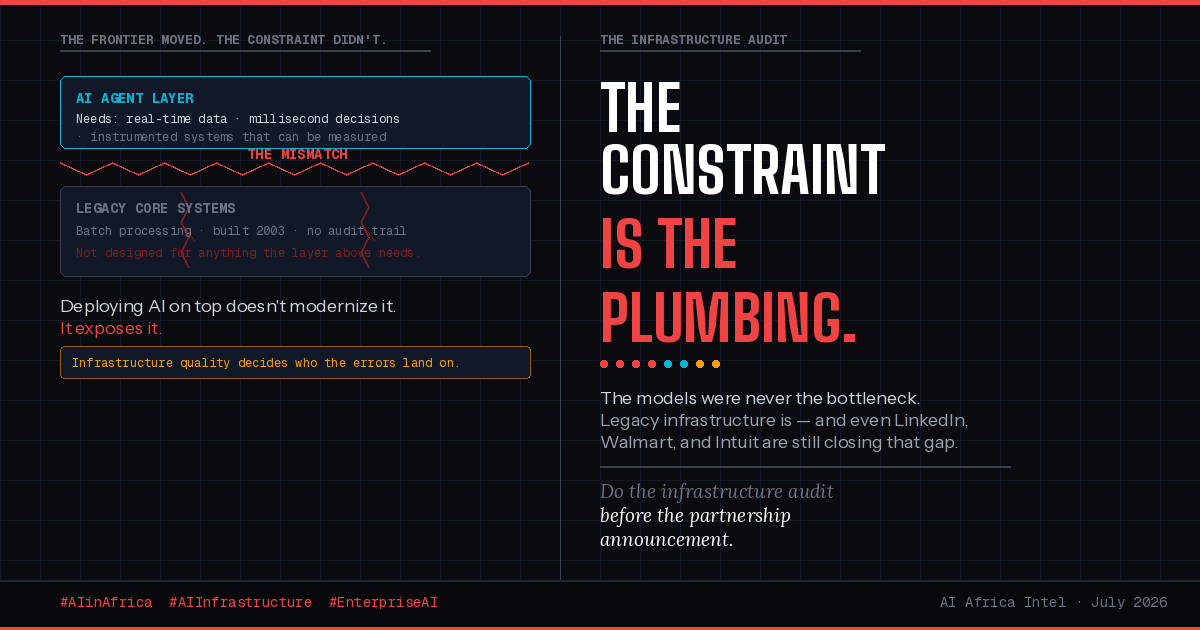
An institution approves an AI roadmap. It selects a vendor. It announces a partnership. The press release goes out. The board receives a briefing on AI adoption progress. And underneath all of it, the core systems, the databases, the transaction ledgers, the data pipelines, are still running on architecture built in 2003, optimized for batch processing, and completely unprepared for the thing they just committed to building on top of them.
This is not a hypothetical failure mode. It is the dominant failure mode, and the most sophisticated enterprises in the world confirmed it publicly this week.
At VB Transform 2026, infrastructure leaders from LinkedIn, Walmart, and Zendesk said what enterprise AI teams have been learning the hard way: the models are not the bottleneck. Legacy infrastructure is. The systems underneath. The plumbing that determines whether an AI agent can retrieve, process, and act on data in milliseconds, are what is actually slowing deployment down. These are organizations with engineering depth, infrastructure budgets, and years of AI investment behind them. They are still closing this gap.
African institutions are not LinkedIn or Walmart. That is precisely why this matters more, not less.
The AI strategy conversation across African banks, telcos, and government institutions has been organized, almost entirely, around access. Which model can we reach? Which vendor will partner with us? Can we afford the compute? These are legitimate starting points. They are not the destination. The enterprise AI conversation at the frontier has already moved past access to operationalization: can your underlying systems actually support agents that think and act in real time? Most African institutions have not yet arrived at that question, and many are approving AI roadmaps without ever asking it.
Consider what agent-ready infrastructure actually requires. AI agents do not wait for nightly batch runs. They pull data, make decisions, and trigger actions in milliseconds. That demands low-latency data access, real-time integration layers, and instrumented systems that can generate the metrics needed to evaluate whether any of it is working. Most African banks and public institutions are running core banking systems and government databases that were not designed for any of those requirements. Some of this infrastructure dates to the 1990s. Deploying a frontier AI layer on top of it does not modernize it. It exposes it.
Intuit, one of the most AI-mature enterprises in the world, scrapped its agentic architecture twice in four months before finding a workable pattern. Its VP of AI described this as the fast path. The lesson is not that AI agent deployment is impossible. The lesson is that even organizations with the resources to iterate rapidly cannot shortcut the architecture problem. African enterprises being pitched plug-and-play AI agent solutions by vendors who do not mention infrastructure debt should treat that omission as a credibility signal.
There is an equity dimension to this that is worth naming directly. The institutions most likely to absorb the cost of getting this wrong are not the ones that will bear the consequences. A bank that deploys an AI credit-scoring agent on top of fragmented, poorly instrumented data infrastructure does not primarily expose its shareholders to risk. It exposes the people whose loan applications get processed by a system making decisions on bad inputs, with no audit trail, and no recourse mechanism. In contexts where regulatory oversight of AI deployment is still nascent, that gap between the institution that acts and the person who is affected is very wide. Infrastructure quality is not a technical question in isolation. It determines who the errors land on.
The Kimi K3 release adds a dimension that African policymakers should be tracking separately. Moonshot AI, the Beijing-based company backed by Alibaba, released what it describes as a 2.8-trillion-parameter open-source model rivaling leading US frontier systems. The significance is not the benchmark. It is the strategic geometry. African institutions that have been operating on the assumption that their credible AI options run through US-headquartered vendors now have a third axis to evaluate, one with different dependency structures, different sovereignty implications, and different cost profiles. Open-source frontier capability from a non-US actor changes the negotiating position of any government or institution that chooses to engage with it. Whether African policymakers in Uganda, Nigeria, Kenya, or Egypt are actively mapping these implications is a different matter.
OpenAI CFO Sarah Friar introduced a practical enterprise AI scorecard this week: useful work per dollar, cost per successful task, dependability, return on compute. It is a sensible framework for organizations that are already generating the data needed to apply it. Most African enterprises are not yet at that baseline. Before useful work per dollar can be measured, systems need to be instrumented well enough to define what useful work means in their specific context, capture whether it happened, and attribute cost accurately. That prior instrumentation work is unglamorous, expensive, and invisible to a board that is looking for AI progress metrics. It is also the thing that determines whether the AI investment that follows is recoverable.
None of this argues against African institutions pursuing AI. The argument runs the other direction. African institutions that do the infrastructure audit work now, before committing to vendor architectures that assume a readiness they do not have, will be in a materially stronger position than those that skip it. The organizations that will extract real value from AI agents are the ones that can tell, with precision, whether the agents are working. That requires instrumented systems. It requires data that is clean enough, current enough, and accessible enough to support real-time decision-making. It requires, in short, the unglamorous work that comes before the partnership announcement.
On most African boards where AI is on the agenda, that work is not yet on the agenda. The model selection conversation is happening. The vendor evaluation is happening. The infrastructure audit is not. That sequencing produces the appearance of an AI strategy while deferring the problem that will eventually determine whether the strategy delivers anything.
The frontier has moved. The constraint is the plumbing. African institutions that understand this now are not behind. They are in a position to build something that will actually hold.
What I’m Watching
1. The bottleneck was never the model — VentureBeat →
Infrastructure leaders from LinkedIn, Walmart, and Zendesk said it plainly at VB Transform 2026: legacy systems, not model capability, are what is slowing AI agent deployment down. These are organizations with engineering depth and multi-year AI investment behind them. They are still closing this gap. For African banks, telcos, and government institutions running core systems built in the 1990s and early 2000s, the implication is direct: approving an AI roadmap without auditing the data infrastructure underneath it does not produce an AI strategy. It produces a press release. The frontier conversation has moved from access to operationalization. Most African institutions have not yet made that shift, and the vendors selling them frontier AI capability are not volunteering the distinction.
2. Kimi K3 changes the sovereignty geometry, not just the benchmark — VentureBeat →
Moonshot AI, backed by Alibaba and based in Beijing, released Kimi K3 this week: a 2.8-trillion-parameter open-source model it claims rivals leading US frontier systems. The benchmark debate will run its course. What matters more is the structural shift. African governments and enterprises that have been operating as though their only credible AI options run through US-headquartered vendors now have a third axis to evaluate, one with different dependency structures, different cost profiles, and different sovereignty implications. As US export controls tighten around frontier AI, China is releasing capability openly. Whether policymakers in Nigeria, Kenya, or Egypt are actively mapping what that changes about their negotiating position is a different matter. The option now exists. That alone changes the calculus.
3. The ROI scorecard assumes infrastructure that most African enterprises do not yet have — OpenAI Blog →
OpenAI CFO Sarah Friar introduced a practical enterprise AI measurement framework this week: useful work per dollar, cost per successful task, dependability, return on compute. It is a sensible framework. It also implicitly assumes that the underlying systems are already instrumented well enough to generate the data needed to apply it. That assumption does not hold for most African enterprises. Before useful work per dollar can be measured, systems need to be instrumented well enough to define what useful work means in context, capture whether it happened, and attribute cost accurately. That prior instrumentation work is unglamorous, invisible to a board looking for AI progress signals, and the thing that determines whether any AI investment that follows is recoverable. The scorecard is the right destination. Most African institutions have not yet done the work that makes it usable.
One Question
If your institution ran a genuine infrastructure audit today — not a vendor readiness assessment, but an honest look at whether your core systems can support real-time data retrieval and decision-making — what would it find, and who in your organization is currently authorized to act on that answer?