The Version Underneath It
BBVA's 120,000-employee rollout is the benchmark. The infrastructure, governance, and geopolitical assumptions underneath it are the lesson.

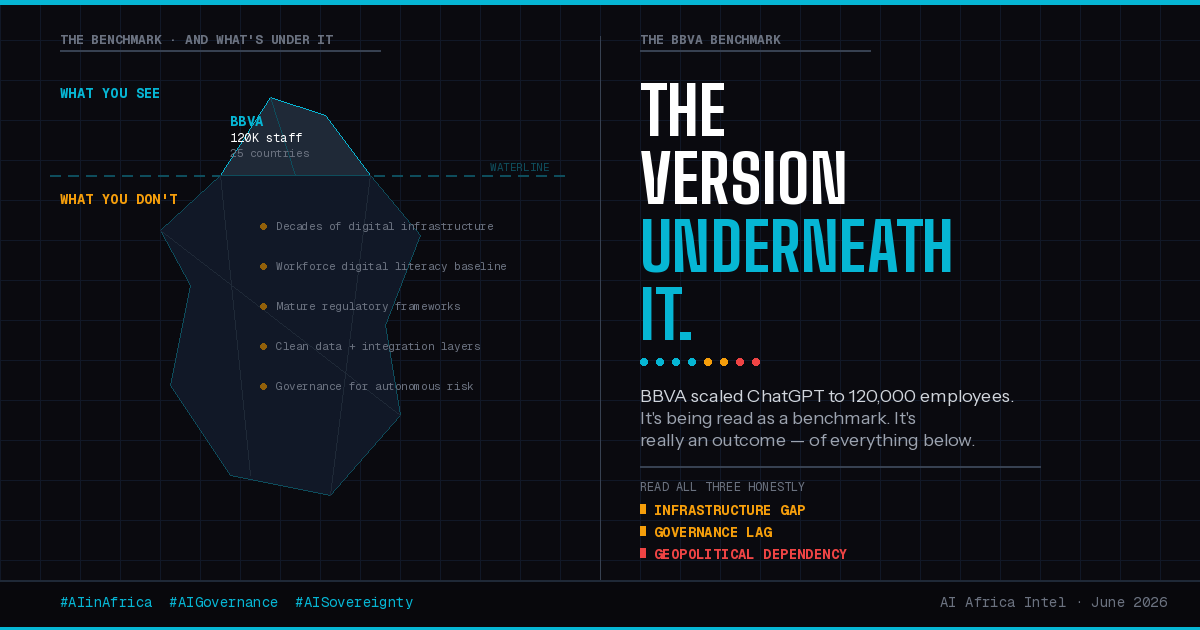
This week, BBVA — one of Europe’s largest financial institutions announced it would scale OpenAI’s ChatGPT Enterprise to all 120,000 of its employees across 25 countries. The headline writes itself: this is what AI adoption at scale looks like. African banking executives are already reading it as a benchmark.
The version worth reading more carefully is the one underneath it.
BBVA built that deployment on top of decades of digital infrastructure investment, a workforce with baseline digital literacy, and a regulatory environment that, whatever its flaws, has spent years developing frameworks for exactly this kind of institutional technology risk. The 120,000-employee rollout is not the starting point. It is the outcome of a long chain of prior decisions, investments, and institutional capacity that most African banks are still in the early stages of building.
This is not an argument that African financial institutions cannot get there. It is an argument about what “getting there” actually requires, and why the current conversation is skipping the hard part.
The hard part is infrastructure; not in the abstract, but in the specific. AI agents do not run on aspiration. They run on compute, on clean data pipelines, on integration layers that connect legacy core banking systems to modern APIs, on security architectures capable of managing autonomous system interactions. Google DeepMind is now funding research into what happens when millions of AI agents interact simultaneously — the concern being that at sufficient scale, agent-to-agent behavior produces emergent risks that no single institution anticipated when it made its deployment decision. That is a frontier problem for institutions that have already deployed. For African banks still deciding whether and how to enter, it is a preview of what the governance conversation needs to include before the first agent goes live, not after.
The geopolitical layer compounds this. The US government’s directive forcing Anthropic to suspend foreign national access to its most capable models is not an isolated event. It is the first legible signal of a dynamic that has been building for years: frontier AI is increasingly treated as a strategic national asset, and access to it is subject to the same logic as semiconductor export controls or satellite technology restrictions. African institutions that have built their AI strategies around access to foreign frontier models now have a concrete reason to ask what happens to those strategies when geopolitical weather changes. The answer, for most, is uncomfortable.
This is the dependency problem in its sharpest form. It is not that foreign models are bad or that using them is wrong. It is that building critical operational infrastructure on systems you do not control, cannot audit, and can be cut off from during a diplomatic disagreement is a specific kind of institutional risk. On most African boards where AI is on the agenda, this risk does not yet have a line item. It probably should.
The African governments now racing to build AI infrastructure — the signal that has moved from policy frameworks to actual infrastructure spending across several countries — are responding to exactly this logic, even if it is not always articulated that way. Sovereign data infrastructure, local language models, domestic compute capacity: these are not just development priorities. They are hedges against a world where AI access becomes a geopolitical lever. The question is whether the execution capacity exists to turn the announcements into operational reality before the dependency deepens further.
There is a more fundamental equity question embedded in all of this, and it concerns who inside African institutions benefits when AI deployment does happen. BBVA’s 120,000-employee rollout is, among other things, a workforce transformation event. Roles change. Some disappear. New capabilities are required. The institutions that manage that transition well invest in retraining, in change management, in understanding which parts of the workforce are most exposed and designing accordingly. The institutions that manage it poorly treat AI deployment as a technology project rather than an organizational one, and the people who bear the cost of that distinction are almost always those with the least institutional power; frontline staff, contract workers, roles concentrated in back-office operations that are easiest to automate and hardest to retrain for.
African financial institutions deploying AI agents will face this same dynamic. The difference is that the baseline is different: digital literacy gaps are wider, retraining infrastructure is thinner, and labor protections for the workers most exposed are weaker. A deployment that looks like operational efficiency from the boardroom can look like displacement without a safety net from the operations floor. Getting this right requires treating inclusion as a design constraint from the beginning, not a communications problem at the end.
None of this is a case for slowing down. The institutions that build genuine AI capability now, on their own infrastructure, with their own data, governed by frameworks they actually control will have options that the ones waiting do not. OpenAI’s confidential S-1 filing with the SEC is a marker of industry maturation: public market scrutiny will demand transparency around safety, governance, and deployment metrics that will eventually set international benchmarks. African AI companies and institutions that have been building toward those standards will find international investment easier. The ones that have not will find the gap harder to close the longer they wait.
The BBVA benchmark is real. So is the infrastructure gap, the governance lag, and the geopolitical dependency risk. The African institutions that will deploy AI well are the ones that read all three honestly, not just the headline.
What I’m Watching
1. The dependency risk just got a name and a date — VentureBeat →
The US government’s directive forcing Anthropic to suspend foreign national access to its most capable models is not a one-off. It is the first export control applied directly to a frontier AI system, and it follows the same logic that has governed semiconductors and satellite technology for decades: when a capability is deemed strategically significant, access becomes a diplomatic instrument. African institutions that have built AI roadmaps around Claude, GPT-4, or any foreign frontier model now have a concrete, dated example of what dependency looks like when geopolitical weather shifts. The question for boards and strategy teams is not whether this will happen again. It is whether the current architecture survives if it does.
2. BBVA’s rollout is an outcome, not a model — OpenAI →
One hundred and twenty thousand employees, one enterprise platform, one headline. What the BBVA deployment demonstrates is not a blueprint African financial institutions can lift and apply — it is the endpoint of years of digital infrastructure investment, workforce development, and regulatory engagement that most African banks are still building toward. The risk is that executives read the scale and benchmark against it without reading what preceded it. Deploying AI agents on top of fragmented core banking systems, thin digital literacy baselines, and governance frameworks that have not yet addressed autonomous system risk is a different undertaking entirely. The benchmark is real. The infrastructure gap between the benchmark and the current starting point is equally real, and conflating the two is how deployments go wrong.
3. African governments are spending, not just talking — the execution question is next — TechCabal →
The shift from AI ethics frameworks to actual infrastructure spending is meaningful. Sovereign data infrastructure, local language models, domestic compute capacity — these are no longer just policy aspirations across parts of the continent; they are budget line items. That matters, because the geopolitical case for building them has never been clearer: the Anthropic export restriction arrived the same week African presidents were announcing infrastructure races. The harder question is execution. Announcements and disbursements are different things. Data centers require power infrastructure that is itself uneven. Local model development requires ML talent pipelines that most countries are still assembling. The direction is right. Whether the capacity exists to move from announcement to operational reality before the dependency deepens is the question the next eighteen months will answer.
A Reflection
The lens I keep returning to this week is dominance — not dominance in the competitive sense, but the quieter kind. The kind where one framing of a problem becomes so prevalent that alternatives stop feeling like alternatives. They start feeling like naïve objections.
In AI conversations about Africa, that dominant lens is adoption. Are African businesses using AI yet? Are governments ready? Is the infrastructure there? The whole conversation is organized around a single question: can Africa receive what has already been built?
What I keep noticing is how much that framing costs us before we even open our mouths. When adoption is the lens, the design choices have already been made elsewhere. The training data decisions have already been made. The governance assumptions are already baked in. Africa arrives at the table to discuss implementation, not architecture.
The counter-lens — Africa as a site of original design, not just deployment — exists. It shows up in specific places, in specific work. But it has not yet become dominant. It is still the thing you have to argue for, which means it is still the exception.
That asymmetry is what I cannot stop sitting with. Not because it is new, it isn’t, but because the window for shifting it is not permanently open. The foundational choices in AI infrastructure, in data governance, in what problems get defined as worth solving, are being made now. A lens that stays marginal during that window does not automatically recover influence later.
So the question underneath this week’s thinking is not whether African builders are talented or whether African data is valuable. Those arguments have been won, at least rhetorically. The harder question is whether the dominant framing shifts before the architecture is locked and what it would actually take to make that happen, not as a rallying call, but as a practical matter of who is in which rooms and what they are being asked to decide.
One Question
If your institution’s AI roadmap depends on access to a foreign frontier model and that access disappeared tomorrow, what would you actually do, and does anyone in your boardroom have a real answer to that question?